Most guest post pitches don't fail because of bad writing. They fail because the person sending them hasn't actually thought about what the editor needs. The pitch lands in an inbox alongside dozens of others, and the editor — who's already got a content calendar to manage — gives it about 15 seconds before deciding whether it's worth a reply.
Understanding what makes those 15 seconds work in your favor changes your acceptance rate significantly. And understanding what the article itself needs to look like once you get past that initial gate makes the difference between a one-time placement and a site that invites you back.
The Editor's Actual Problem
Editors at content-driven publications aren't sitting around hoping someone will send them an interesting pitch. They're managing a queue, responding to their own editorial calendar, dealing with contributors who miss deadlines, and trying to maintain quality on a site that probably doesn't have a massive content budget.
The best pitch you can send is one that solves their problem rather than creating another one. That means: a clear topic that genuinely fits their site, a headline that works for their audience, a clear outline that shows you've thought about the piece, and a writing style that demonstrates you can actually produce it. The more work you've already done, the easier you are to say yes to.
What Your Pitch Email Needs
A pitch email has one job: get a reply. It's not the place for a long bio or a portfolio of every piece you've ever written. Here's what it actually needs:
The most common pitch mistake: Leading with credentials and bio before saying what the article is actually about. Editors don't care about your background until they care about your idea. Lead with the idea.
An Example That Works
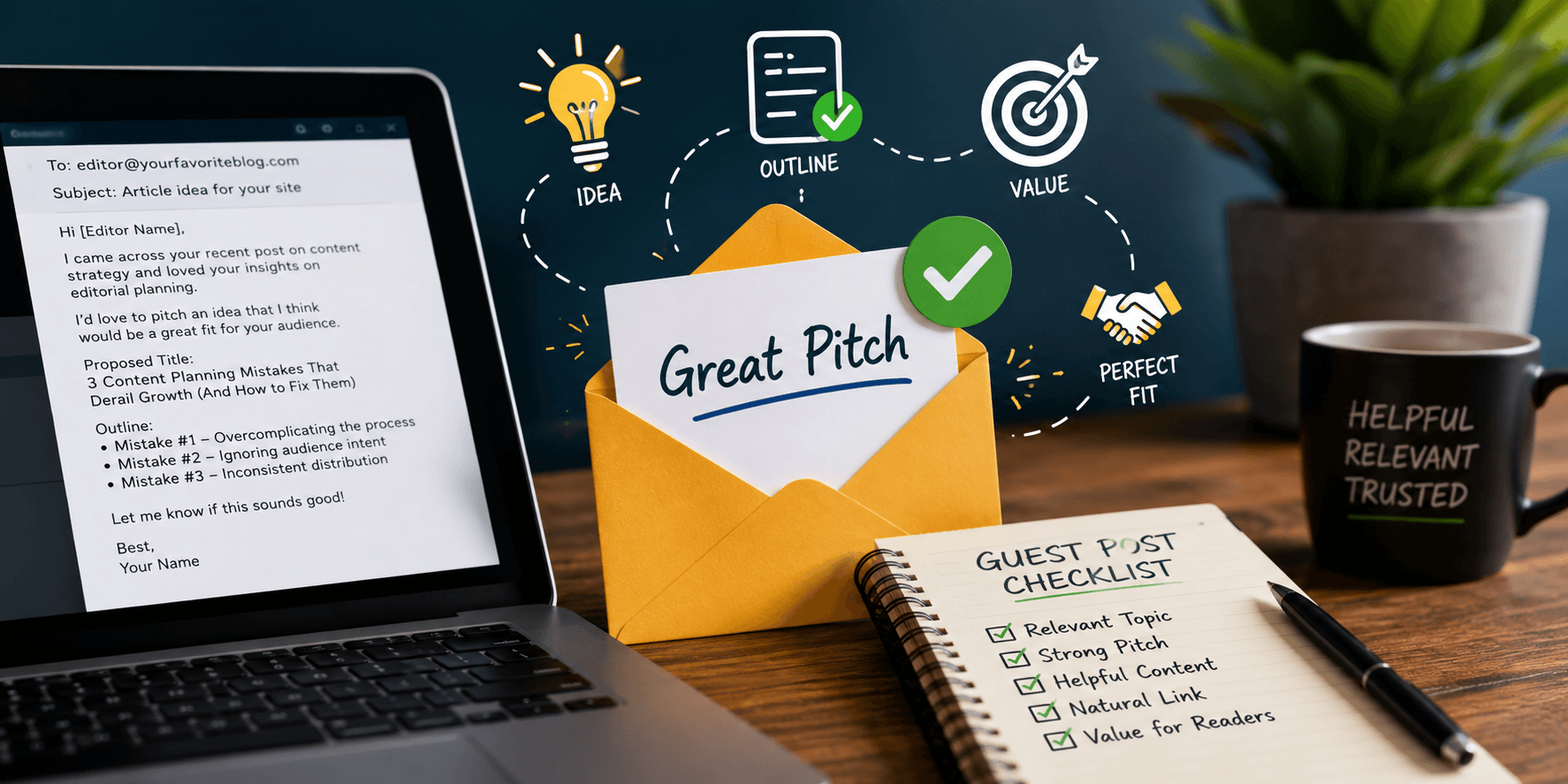
Here's roughly what a pitch email that lands looks like in practice:
Hi [Name],
I came across your piece on content strategy for small teams last week — the point about editorial debt was something I hadn't seen framed that way before.
I wanted to pitch something related: a practical guide on why most B2B content calendars collapse between January and April — specifically, the planning mistakes that look fine on paper but fail under real execution pressure.
Main angles I'd cover:
- Why quarterly planning doesn't account for how long content actually takes
- The "hero content" problem — over-investing in one format at the expense of distribution
- A simpler planning model that scales down gracefully when things get busy
Here's a recent piece of mine on a similar topic: [link]
Happy to send a full draft if this sounds like a fit.
[Name]
That's it. Three short paragraphs, a clear idea, evidence you can write, and a low-friction close. Anything longer than this starts to work against you.
The Article Structure That Gets Through Editorial Review
Once your pitch is accepted, the article itself faces a different kind of evaluation. A real editor isn't just checking for grammatical errors — they're asking whether this piece genuinely serves their readers, whether the tone matches their site, and whether they'd feel comfortable putting their publication's name on it.
Most guest post articles that get rejected at the article stage have one of three problems: they're too promotional, they're too generic, or they clearly weren't written with the host site's actual audience in mind. Here's the structure that avoids all three:
The Tone Problem Most Writers Get Wrong
Every publication has a voice. Some are conversational. Some are analytical. Some lean formal. Some use humor. Reading one article from the site is not enough to understand the voice — read five or six, across different authors if possible, and identify what the through-line is.
The guest posts that get accepted and invited back are the ones that feel like they belong on the site — not like a good article that was imported from somewhere else. That requires actually spending time with the publication rather than writing a generically good piece and hoping it fits.
This is especially important for the opening paragraph. Editors can tell within the first three sentences whether a writer understood their site or whether they wrote something hoping it would pass.
On the Link Placement
This is usually where guest posts get into trouble. The link that you're placing needs to appear natural — meaning it adds something to the reader's experience, not just to your backlink profile. The best contextual links are ones where a curious reader might actually click through because the anchor text and surrounding context make it seem genuinely useful.
Avoid placing links in a sentence that exists solely to be a link vehicle. Avoid anchor text that reads like an ad ("best link building services available"). And avoid placing the link in the introduction or conclusion — editors remove those almost automatically because they read as promotional.
Mid-body placement, in a paragraph that's topically close to your linked page, with natural-reading anchor text — that's the combination that survives editorial review and reads clean to Google.
A practical test: Read the paragraph containing your link aloud, replacing the anchor text with the words "click here." If the sentence still makes logical sense and the link still adds value, the placement is probably good. If it sounds strange without the specific anchor, the placement is probably too engineered.
Why Content Quality Directly Affects Link Value
This is worth saying directly: the quality of the article surrounding your link affects how much that link is worth. A link inside a 400-word piece of thin, generic content on a site full of similar low-effort guest posts is a different signal than a link inside a well-researched, genuinely useful 1,200-word article on a site that clearly cares about what it publishes.
Google's algorithms have gotten better at evaluating content quality at the page level. The editorial bar for the article itself is not just about getting accepted — it's about the long-term value of the placement you're earning.
The easiest mental model: write every guest post as if your name is going on it and people in your industry might read it. That standard produces articles that get accepted, stay live, and carry real link equity over time.